For this project, we created a series of maps with the NBA player dataset using Tableau, visualizing the number of international NBA players by country and by era (1945–1980, 1981–2000, 2001–2020, and the grand total). To do this, we had to create calculated fields of “Is International” for where the variable Birth Country did not equal US. We then mapped the birth country using the “Is international” filter across “Start Time Period” which we also created using a calculated field where bins were made based on a player’s “Start Year”. We included the count measure for “_key” in the marks section with values displayed with both numbers and by a color scheme (displayed in the added legend). We then calculated both the column and row values and displayed the column values as a textbox and the row values as a grand total map. The resulting map is a choropleth map style, with numbers and color gradients indicating player counts in each country over 3 different time periods and text showing total countries and players for that time period. This allows me to see the progression and trends of certain countries and regions being represented in the NBA so we can explore my group’s topic on international barriers to the NBA and how these have changed over time. The graphs can also help explain and provide insight to specific contributing historical events in certain regions or around the world.
Note: The US was not included in the map to be able to specifically model and explore the changes in international representation in the NBA. Including the US in the color map would have diluted the significance of all other countries.
Analysis:
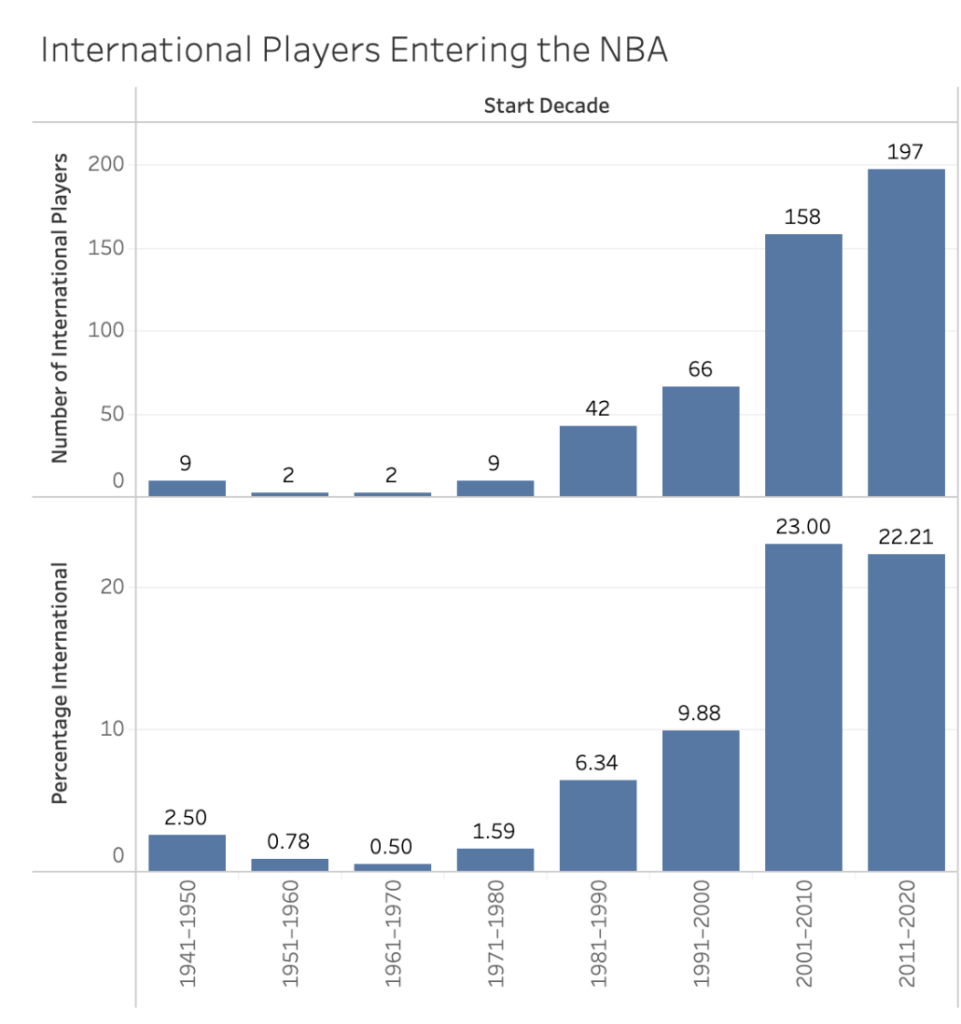
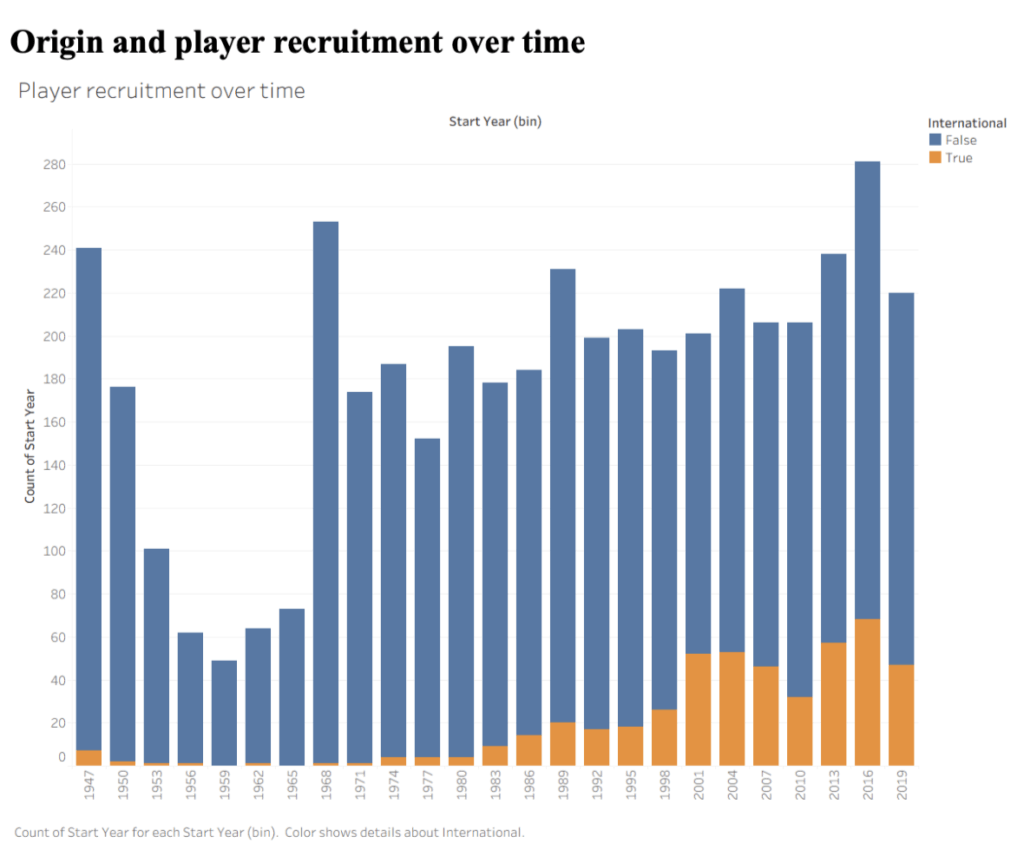
The progression across maps shows both the widening geographic scope, from 14 countries in the earliest period to 85 countries in total (71 between 2001-2020), and the sharp increase in representation from those countries, most notably from Canada (with 41 players), France, Australia, and a range of European, African, and Latin American nations. The spatial concentration of players in certain regions underlines historical links: for example, Canada’s proximity to the U.S. and basketball’s popularity there, but also the popularity and history of players and NBA initiatives. While Canada, Russia, and Europe were represented in 1945-1980 and see a steady increase across time, areas like South America, China, and parts of Africa have seen an exponential increase since 2000.
These trends are best explained by certain historical events found in the secondary literature. South America saw increased NBA representation due to the rise of top-level talent from countries like Argentina and Brazil following the 2016 Olympics in Brazil. The event marked the first the Olympics was ever held in South America and allowed the continent to have exposure to the NBA’s high level of talent, wealth, and infleuence as team USA dominated, earning a gold medal behind cultural icon and now billionaire Lebron James (Wang, 2025).
Africa's expansion as a talent pipeline was developed by the NBA's direct investment in basketball infrastructure, notably through the creation of the Basketball Without Borders camp starting in 2003 and the launch of the Basketball Africa League (BAL) in 2021. The league invested heavily in scouting, development programs, and its partnership with FIBA (Fédération Internationale de Basketball) to expand its global impact and market in the continent(Gulak-Lipka, 2020). China experienced particular growth in NBA representation after the arrival of Yao Ming, who was drafted first overall in 2002 and became an international superstar. Yao’s impact sparked massive NBA popularity in China, resulting in millions of new fans and commercial partnerships. This, in turn, motivated more investment in youth basketball and increased opportunities for Chinese players to pursue NBA careers (Motomura, 2014). The substantial increases in South American, African, and Chinese NBA players during this period reflect the NBA’s shift to global recruitment, targeted development programs, and the powerful “role model effect” of successful international stars. The map shows that every country has experienced growth in NBA representation over time which figures to only continue with increasing globalization, media coverage in foreign countries, financial growth within the NBA, increasing popularity of the sport, and a narrowing skill gap between the US and other countries. Socially and culturally, this broadening of the league’s base has enriched the NBA, increasing diversity, expanding basketball’s global popularity, and reinforcing the idea of the NBA as a truly international league.
Note: The assumption that the skill gap is lowering and the popularity of the NBA is expanding lies under the assumption that the NBA is the ideal and premier league/destination for any player. At the current moment, this assumption is allowed to be made as the NBA offers a salary nearly 15 times higher than the next professional basketball league (the Euroleague) and is notorious for being the greatest basketball league in the world in terms of talent, popularity, and revenue (Lautier, 2023).