Narrative

Introduction

When the NBA was created in 1946, the league was predominantly American with less than ten international players joining in the first few years. As the league has grown and media coverage has expanded to foreign countries, the NBA has evolved from a predominantly American league into a global showcase of basketball talent, reflecting the sport’s growing international reach and influence. This project explores the question: how has the impact and influence of international players changed over time in the NBA?

By analyzing data from the “NBA All-Time Players” dataset on Kaggle, which includes information on player birth origins, performance statistics, and accolades, we trace the rise in international player participation and performance since the league’s early decades. Our visualizations highlight trends in the number of players entering the league, performative metrics like career points per game, player recognition through all-star appearances, and differences in salaries for international players. Together, this data helps argue that international players are not only entering the league at increasing rates but are also performing and being recognized on par with their American counterparts, an indication of basketball’s globalization and the narrowing gap in the sport’s inequalities and barriers worldwide.

As a complex ecosystem where teams compete for players, who function as both agents and commodities, and seek to extract revenue from multiple markets of fans, the economics of international professional basketball and the NBA are well studied. Economically, the value of a player is multifaceted, and there are varying metrics for evaluating player quality. The performance of a teams’ players on the court affects the team’s ability to win, which is correlated with ticket, streaming, and merchandise sales, but players can also bring value to teams in their existing fanbases and influences. Most scholars of sports economics agree that teams in the NBA make decisions when creating their rosters without fully utilizing the full information available about player performance and potential future value for the team. This is to some extent, to be expected, the disparity between the salary a player is signed at and their actual value, as the process of player acquisition involves bidding between multiple teams, meaning that the team which has most overestimated a player’s value will typically be the one to sign the player and therefore be forced to overpay them. The width of the gap between player value and salary increases in cases where less is known about the player, as less information leads to less precise estimates of value by teams, resultantly players who are least well-understood by the league will be the most overpaid. Studies have identified multiple competing periods of NBA history where international players were overpaid relative to their US-born counterparts, a consequence of less-robust international scouting which limited information about international players and thus inflated their salaries. Another contributing factor to imprecision are the variety of measures by which on-court can be evaluated, with the metric a team uses influencing the accuracy of their estimation of player value. While there are numerous studies examining disparities between international players and US-born players, none that we found have made attempts to specifically examine player origin as a factor in pay or hiring beyond the broad category of “international.”

We are working on analyzing the historical and present-day representation of international players in the NBA because we want to find out how a player's country of origin affects their recruitment, performance, and economic outcomes in the league, so that we can help others understand how globalization has shaped equity and recognition within one of the world’s most prominent professional sports organizations. Our project is guided by these central research questions:

(1) What are the historical trends of international player representation in the NBA?

(2) What factors have been most influential in addressing international barriers?

(3) How well do international players perform compared to US born players?

(4) Are international players recognized and compensated fairly (performance-driven) compared to US bird players?


These questions enabled us to investigate whether being an international player still poses barriers to success in the NBA. Through our analysis of roster data, player statistics, and salary information over time, we found that the presence of international players in the league has steadily increased, and that these players are not only contributing at high levels but are also receiving comparable recognition and compensation to their U.S.-born peers. International players are earning All-Star selections, MVP awards, and contracts that rival those of domestic players, signaling that the NBA has become an increasingly equitable space for talent from around the world.


Significance

This finding is significant because it challenges familiar narratives in labor and globalization literature, which often portray international workers as being underpaid or undervalued. In contrast, the NBA functions as a more level playing field; one where performance, rather than origin, drives outcomes. Our project contributes a new perspective to existing research by showing that globalization in professional sports does not necessarily lead to inequity, and in some cases, may support a more inclusive and performance-based model of success. Ultimately, our work helps others understand that the NBA's growing internationalization is not just visible in numbers; it’s reflected in the real opportunities, rewards, and visibility available to international players. By connecting our data to broader questions about equity, labor, and globalization, we aim to provide insight into how professional sports can adopt more inclusive practices and what that might mean for other industries navigating the integration of global talent.

Timeline

The below timeline outlines the major historical events which shaped the position of international players in the NBA.

Map

For this project, we created a series of maps with the NBA player dataset using Tableau, visualizing the number of international NBA players by country and by era (1945–1980, 1981–2000, 2001–2020, and the grand total). To do this, we had to create calculated fields of “Is International” for where the variable Birth Country did not equal US. We then mapped the birth country using the “Is international” filter across “Start Time Period” which we also created using a calculated field where bins were made based on a player’s “Start Year”. We included the count measure for “_key” in the marks section with values displayed with both numbers and by a color scheme (displayed in the added legend). We then calculated both the column and row values and displayed the column values as a textbox and the row values as a grand total map. The resulting map is a choropleth map style, with numbers and color gradients indicating player counts in each country over 3 different time periods and text showing total countries and players for that time period. This allows me to see the progression and trends of certain countries and regions being represented in the NBA so we can explore my group’s topic on international barriers to the NBA and how these have changed over time. The graphs can also help explain and provide insight to specific contributing historical events in certain regions or around the world.

Note: The US was not included in the map to be able to specifically model and explore the changes in international representation in the NBA. Including the US in the color map would have diluted the significance of all other countries.


Analysis:

The progression across maps shows both the widening geographic scope, from 14 countries in the earliest period to 85 countries in total (71 between 2001-2020), and the sharp increase in representation from those countries, most notably from Canada (with 41 players), France, Australia, and a range of European, African, and Latin American nations. The spatial concentration of players in certain regions underlines historical links: for example, Canada’s proximity to the U.S. and basketball’s popularity there, but also the popularity and history of players and NBA initiatives. While Canada, Russia, and Europe were represented in 1945-1980 and see a steady increase across time, areas like South America, China, and parts of Africa have seen an exponential increase since 2000.

These trends are best explained by certain historical events found in the secondary literature. South America saw increased NBA representation due to the rise of top-level talent from countries like Argentina and Brazil following the 2016 Olympics in Brazil. The event marked the first the Olympics was ever held in South America and allowed the continent to have exposure to the NBA’s high level of talent, wealth, and infleuence as team USA dominated, earning a gold medal behind cultural icon and now billionaire Lebron James (Wang, 2025).

Africa's expansion as a talent pipeline was developed by the NBA's direct investment in basketball infrastructure, notably through the creation of the Basketball Without Borders camp starting in 2003 and the launch of the Basketball Africa League (BAL) in 2021. The league invested heavily in scouting, development programs, and its partnership with FIBA (Fédération Internationale de Basketball) to expand its global impact and market in the continent(Gulak-Lipka, 2020). China experienced particular growth in NBA representation after the arrival of Yao Ming, who was drafted first overall in 2002 and became an international superstar. Yao’s impact sparked massive NBA popularity in China, resulting in millions of new fans and commercial partnerships. This, in turn, motivated more investment in youth basketball and increased opportunities for Chinese players to pursue NBA careers (Motomura, 2014). The substantial increases in South American, African, and Chinese NBA players during this period reflect the NBA’s shift to global recruitment, targeted development programs, and the powerful “role model effect” of successful international stars. The map shows that every country has experienced growth in NBA representation over time which figures to only continue with increasing globalization, media coverage in foreign countries, financial growth within the NBA, increasing popularity of the sport, and a narrowing skill gap between the US and other countries. Socially and culturally, this broadening of the league’s base has enriched the NBA, increasing diversity, expanding basketball’s global popularity, and reinforcing the idea of the NBA as a truly international league.

Note: The assumption that the skill gap is lowering and the popularity of the NBA is expanding lies under the assumption that the NBA is the ideal and premier league/destination for any player. At the current moment, this assumption is allowed to be made as the NBA offers a salary nearly 15 times higher than the next professional basketball league (the Euroleague) and is notorious for being the greatest basketball league in the world in terms of talent, popularity, and revenue (Lautier, 2023).

Visualizations

1


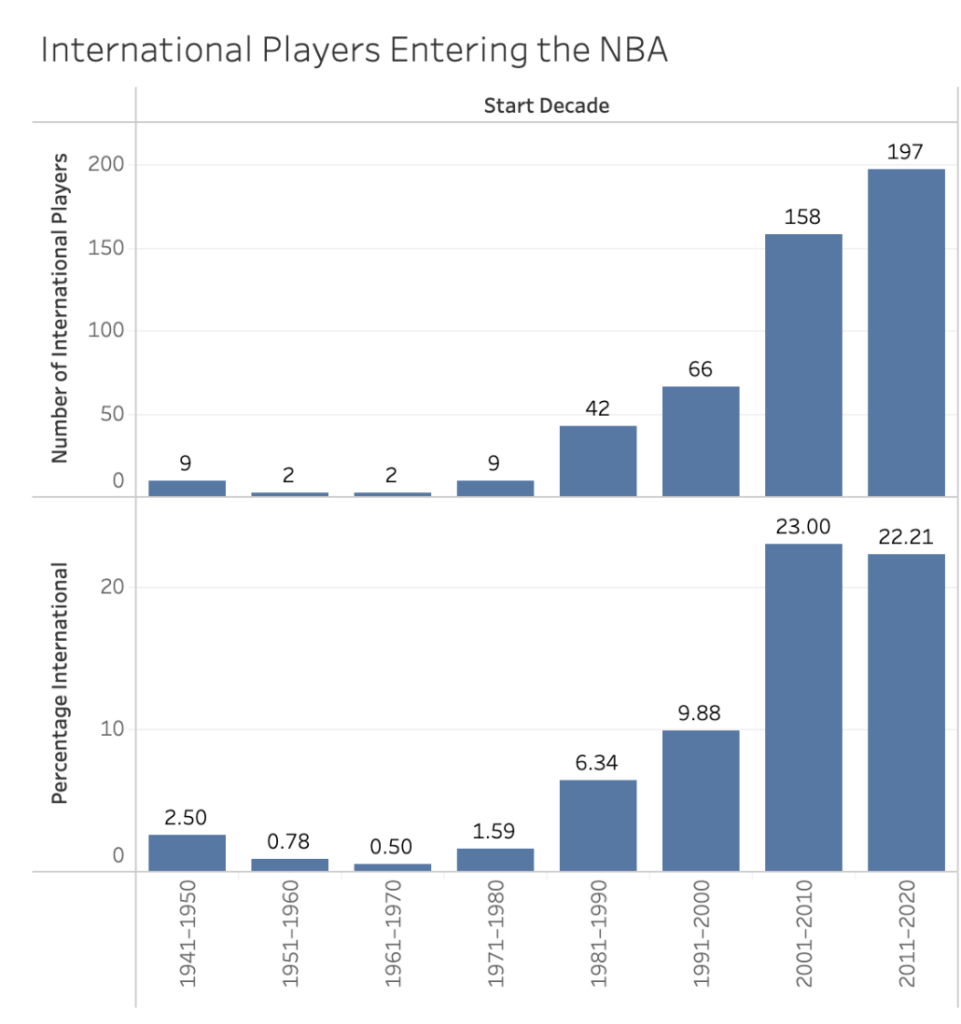
The bar chart shows how the number of international players and their percentage in the NBA have evolved across the last six decades. Initially, in the 1960s and 1970s, the number of International players was low, and their percentage in the league was negligible. However, as the 1980s and 1990s progressed, we start to see a noticeable increase in both the number of International players and their percentage in the NBA. This is likely due to globalization and the NBA’s efforts and initiatives to popularize the NBA across the world. With the US becoming more dominant in publicized world basketball competitions, like the Olympics, the US became a place of interest for international talents. The increasing salaries due to the increasing media coverage and popularity of the league was also a calling point.

Commissioner David Stern (NBA commissioner from 1984-2014) branded around growing cultural icons like Michael Jordan in the 1990’s and merchandise, basketball camps, and coverage of the NBA grew exponentially in foreign countries. The sharpest rise of international players occurred in the 2000s and 2010s, as the NBA became more internationally diverse, with more talent entering the league from Europe, Africa, and Latin America. As basketball, a sport invented in the US, continued to gain increasing global popularity in the early 2000s, international talent continued to improve and narrow the gap between the US and other countries. As a result, the NBA, known for being the best basketball league in the world in terms of financial resources, popularity, and talent, has shifted from being a historically US-centric league to one with growing international representation. This transformation is ongoing and reflects the league's evolving nature, as it embraces talent from all over the globe.

2

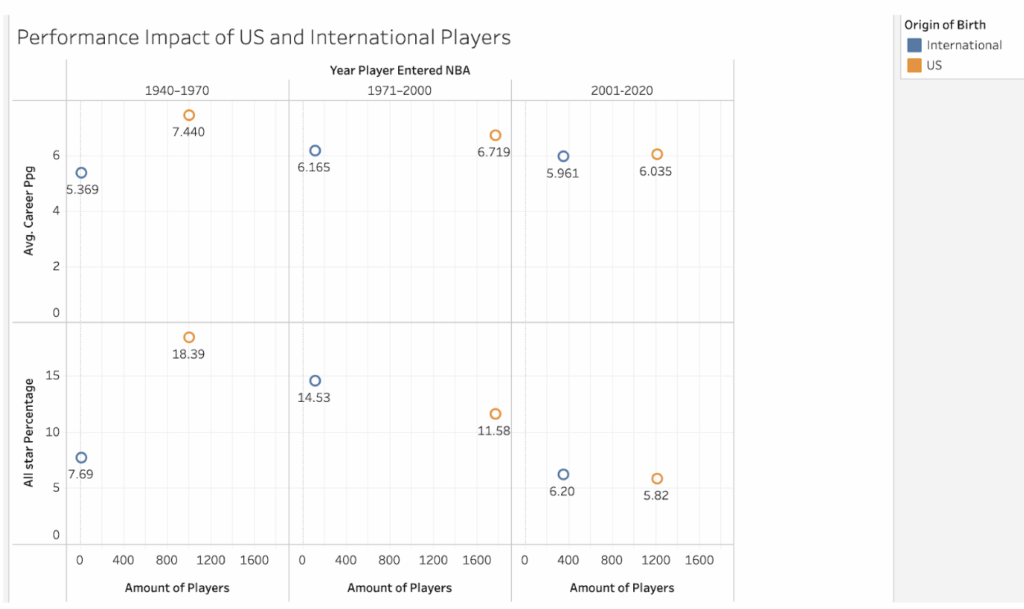
This chart illustrates how the average career performance of international players has evolved over time relative to their U.S. counterparts. In the earliest period (1940–1970), international players had a significantly lower average PPG and All-Star selection rate, but as we see with the extremely small sample size of international players between 1940-1970, this data should be disregarded and not used to make any assumptions about the performance of international players. However, by the 1971–2000 period, international players reached a much greater sample size and scored slightly less points (0.554) than US players. They did however actually receive higher performance recognition, as seen in the 3% higher All-Star selection percentage. This is very interesting and suggests that player recognition and societal favoritism (all-star voting is done by fans and coaches) was aligned with performance and did not contain national biases.

Given the differences in career ppg and all-star % is slightly misaligned, it’s likely that the scoring among international players had slightly more variance than US players (a player with a high ppg and low ppg would average out but still equal one all star player where as two average ppg would average out and not have any all-star players). This is something that would be interesting to access with more research into the data, individual players and their influence in the data, and diving into primary sources to see if there was any potential favoritism to international players (ex: the NBA could have tried to increase number of international all star players to increase global market or even mandated certain policies to make sure international players were included).

The most notable trends in the graphs occur in the 2001–2020 era, where international players not only maintain strong average scoring (6.035 PPG vs. 5.961 for U.S. players) but achieve nearly identical All-Star selection rates. This indicates that not only are more international players entering the league, but they are also having a similar impact and player recognition. Future research should look into salaries of international players to explore if international players are not only recognized but also equally compensated for equal performance metrics. Something that is important to mention from the charts is the decrease in all star % for international players in 2001-2020 when compared to 1971-2000. When examining this, it’s important to note the difference is also represented in the US players. This is likely due to players having longer careers with better and better training methods. This means that there are less all-star players but those players have many all-star appearances. The dip in the data is also likely due to the fact that the data was taken in 2020 and players from 2015-2020 have likely not entered their prime and become an all-star yet. It is important when examining this data to compare international players side by side with their US counterparts. Overall the data suggests that international players perform just as well and are equally recognized as US born players. This trend aligns with the performance-driven nature of basketball and the NBA’s strategic efforts to globalize the sport and expand its international market. Future research should further explore the barriers that international players face in reaching the NBA, as well as the structural and cultural factors in different countries that influence a player's path to the league. It is likely that performance differences among groups of NBA players are minimal because the relative skill gap between the best and worst players in the NBA is very small. Given the elite level of competition; the real disparities may lie in the accessibility and opportunity to reach that level, rather than in talent or ability once players are in the league.

3

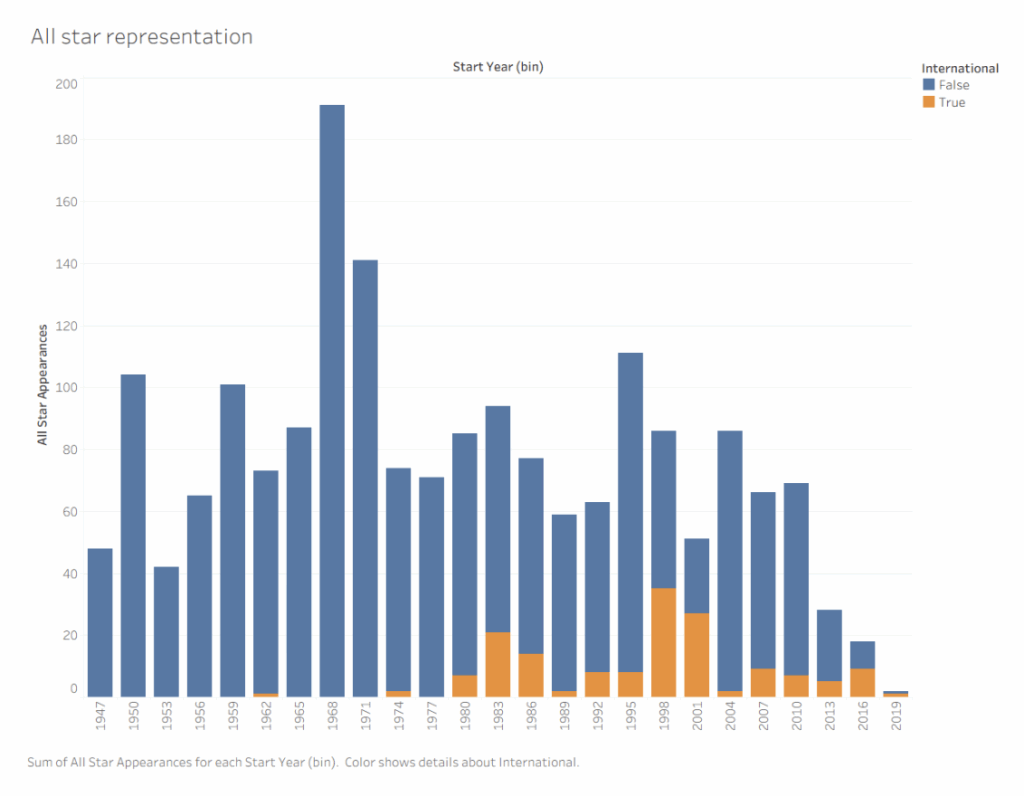
The above image charts the All-Star appearances of domestic and international NBA players based on their start years between the league’s founding in 1947 and 2020. Overall, U.S.-born players have historically dominated the All-Star stage, with international representation only beginning to appear in the early 1960s and remaining minimal until the 1980s. From that point on, international appearances steadily increase, reflecting the NBA’s expanding global influence and the rise of international basketball programs.

A sharp peak in overall All-Star appearances occurs in the early 1970s, a period that aligns with the NBA’s expansion and a particularly deep domestic talent pool. The growth in international representation, however, emerges later, with noticeable momentum in the late 1990s. This aligns with both the NBA’s push into global markets and the emergence of internationally recognized stars who became key figures in the league.

The trends suggest that domestic All-Star representation follows the NBA’s internal cycles of growth and expansion, while international representation is more closely tied to globalization and major shifts in the basketball world. Events such as the 1989 FIBA rule change, which allowed NBA players to compete in international competitions, and the launch of Basketball Without Borders in 2001, likely played a significant role in opening pathways for international athletes. While U.S.-born players still hold the majority, the consistent rise of international All-Stars highlights a long-term structural shift, positioning the NBA as a truly global league.

4

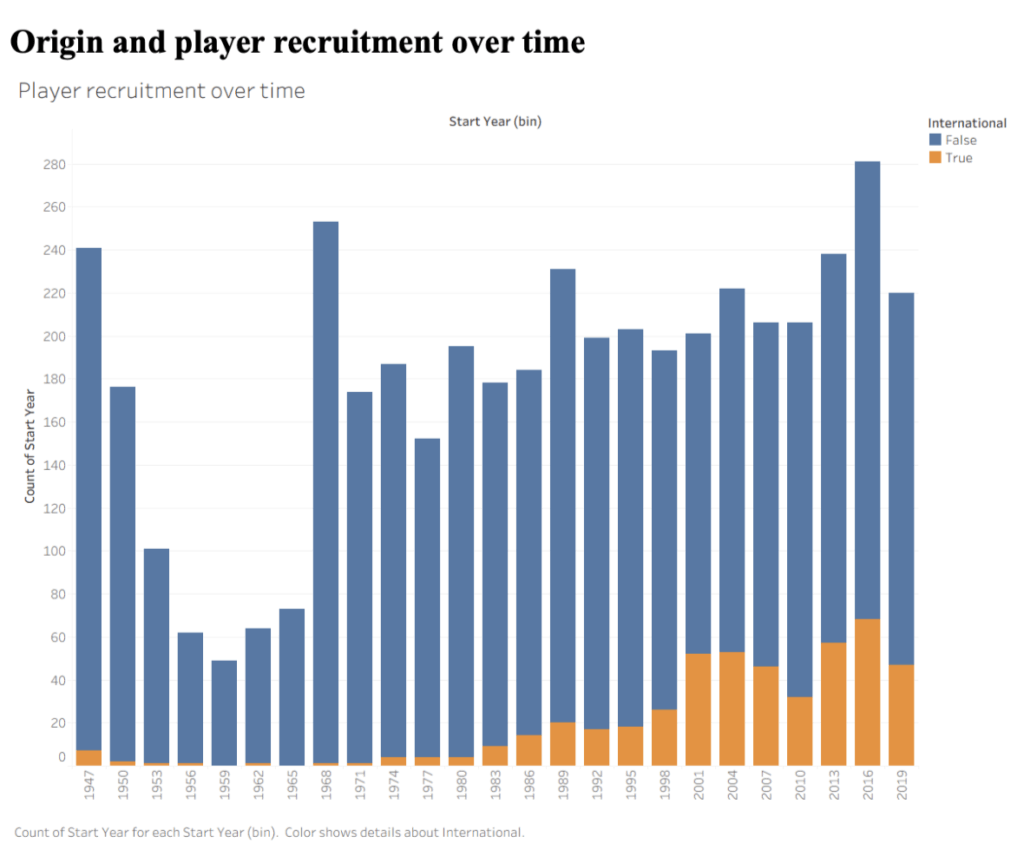
The following visualization charts the rates of player recruitment for domestic and international players over three-year periods between the league’s founding in 1947 and 2020. Periods in league history can be mapped to trends in the recruitment rates. The general trend of player hiring is a gradual increase over time, albeit with a notable dip at the beginning of the league’s history. Unsurprisingly, a large number of players joined during the founding of the league as the Basketball Association of America, with a reduction in the number of new players following that, particularly as teams in both the BAA and National Basketball League struggled financially before their merger.


After the BAA and NBL merged to form the NBA, the league once again began to see success and expansion, most notably in 1970 with the introduction of several new teams, leading to high draft numbers at the beginning of the seventies. This pattern is mostly a function of the league’s own financial situation, with little relationship to world affairs. The world economy, and particularly the American economy, are somewhat reflected in the hiring trends, as there is a slight but noticeable decrease in hiring following the 2008 global financial crisis. The hiring of international players is somewhat independent from most of the league economic history that influenced overall hiring levels, instead being an overall increase from relatively low levels throughout the majority of league history up until the early eighties, at which point international hiring began to accelerate. This change can be attributed both to overall increased economic globalization during that period and specific basketball-related events like the 1989 FIBA rule change and 2001 founding of Basketball without Borders. Notably, the effect of the 2008 crisis is more pronounced on the absolute level of international hires, suggesting that international players were considered more “luxury” picks during a time of financial instability for the league.

5

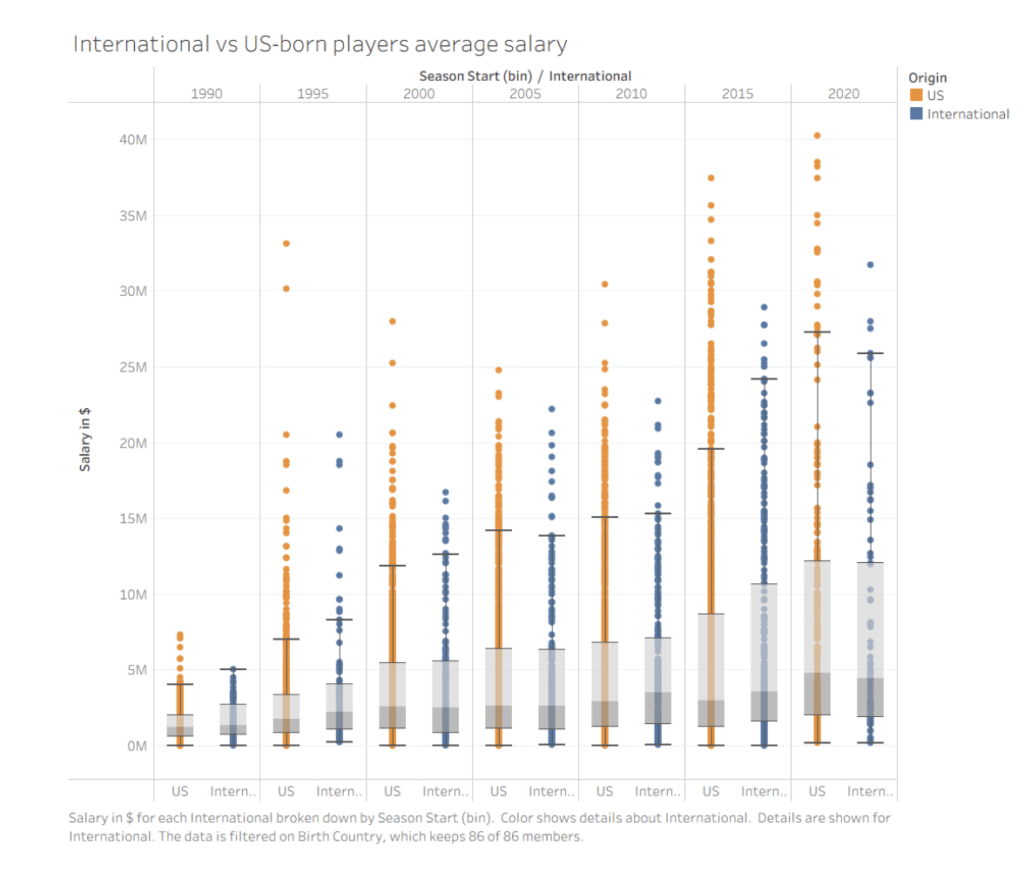
The following visualization graphs trends in payer salary by origin over time from 1990 to 2020, grouped into periods of five years. On the whole, salaries in the NBA are distributed unevenly, with the majority of players compensated at much lower rates than a small number of superstars; as a result it is less useful to only consider average pay when comparing salaries. Additionally, salaries are scaled relative to a player’s expected return for the team, meaning that salary data must be considered in conjunction with player performance.

When observing the chart, there are clear discrepancies between the pay rates of international and US-born players, particularly in the earlier data, when international players tended to be compensated slightly more than US-born players. At this time in league history in the nineties, although basketball was already well-established as an international sport, recruitment pathways for international talent were still limited. As previously discussed, enthusiasm for hiring international players had begun to climb, but the amount of information available for teams when making recruiting decisions was still limited.

A player’s salary is a reflection of their expected return for the team, both in terms of on-court performance, where teams which win often tend to make more money, and the ability to draw in fans, sell merchandise, and tickets. Given that this expected return can only be estimated by a team prior to drafting the player, having less information decreases the accuracy of that estimate. The drafting system used by the NBA tends to send players to the team which is willing to pay them the most money, which is almost always the team which has most overestimated that player’s value, exacerbating the effect of low information estimates. The effect is to overinflate salaries for international players during this period, when, as a group, they were less well-understood than US-born players. Over time, with the introduction of talent development pipelines for foreign players, such as Basketball without Borders, and improved institutional knowledge about international programs, team estimates of player value improved, narrowing the gap between international and domestic players.